
As all oratorical treatises used for teaching purposes, the Rhétoriques by Urbain Boiret, Charles-François Bailly de Messein and Joseph-Marie Boissonnault belonged to manuscript tradition and were never published.
|
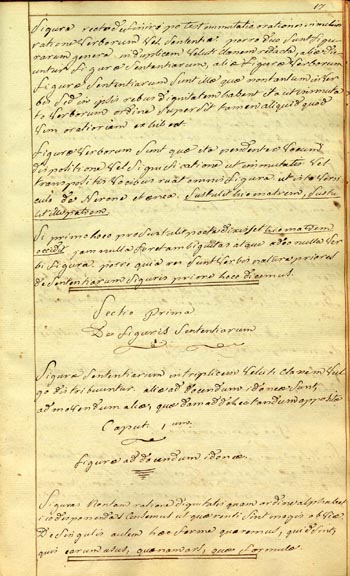
Urbain Boiret taught rhetoric, the art of persuasive speaking, at the Petit Séminaire de Québec during the 1770-1771 school year. The course examined rhetoric's five components. 1. Conception, that is, finding what to say on a subject and gathering arguments. 2. Arrangement, putting the elements of discourse in order. 3. Eloquence, finding the right words and appropriate tone. 4. Gesturing, planning body language. 5. Memorizing or mnemonics. Urbain Boiret (1731-1774), Rhetorica in Seminario Quebecensi data anno 1770. Auctore D.D. Leguerne. Professore D.D. Boiret, bound manuscript, 30,3 x 18,7 x 4 cm, Québec, Musée de la civilisation, Séminaire de Québec Collection M-225. |
 |
|
Although it was written in Latin, its object was to train pupils to use French prose with eloquence. This is clearly shown by the space given to examples taken from the works of 17th and 18th-century French writers. Bailly remained true to jesuit oratorical training by insisting on the need and means to please to better convince. Hostile to obscurantism, this polemicist used an incisive prose made of short and caustic sentences in his various pamphlets: a flawless example of oratorical perfection. Charles-François Bailly de Messein (1740-1794), Rhetorica in Seminario Quebecensi data anno 1774, bounded manuscript, 32,8 x 201, x 3,3 cm, Québec, Musée de la civilisation, Archives du Séminaire de Québec, M-228. |
 |
|
In this letter to Chief Judge, William Smith, who was in charge of an inquiry on educational policy, Bailly speaks in favour of founding a "mixed" university, that is, religiously neutral. Since Bishop Hubert opposed the project, Bailly used a clever oratorical trick: he pretended to attribute his bishop's objections to an imaginary "writer" to ridicule his "inadequacy and self-importance [free translation of French]". Charles-François Bailly de Messein (1740-1794), Copy of the Letter of the Bishop of Capsa, coadjudicator of Québec, &c, to the President of the Committee of Education, &c., 1790, [3], 10, 10, [1] p., 19 cm, 4 t., Montréal, Bibliothèque nationale du Québec. Photo Robert Derome. |
 |
|
A subject of great educational value, rhetoric was the apotheosis of the school degree. Oriented towards the practice of public speaking, oratorical finesse was displayed in exercises that were true ceremonies of speech, destined to demonstrate the effectiveness of discourse and the merits of giving such training to students. That year Joseph-Marie Boissonnault was in charge of the rhetoric class, a position he held until 1794. Joseph-Marie Boissonnault (1766-1834), Exercise on the rhetoric demonstration which will be held in the room of the Petit Séminaire in Québec on 13 August 1792…, , bound manuscript, 21 x 16,7 x 1,3 cm, Québec, Musée de la civilisation, Séminaire de Québec Library, fonds anciens, QMUCSQ011667. |


