
Louis Dulongpré had a great impact on the arts of the period through his work as a portraitist and through his accomplishments in music and theatre. He was also a pioneer of the satirical cartoon, as shown by his correspondence with printer John Neilson.
|
From Montréal, on 5 December 1811, Dulongpré wrote to John Neilson, publisher of the Quebec Gazette. He sent 28 satirical cartoons on "the election in our riding", in which Joseph Roy and James Stuart were the candidates. "Time being too short to print more, I will send you 150 more by the next post […] Price is 2 shillings [free translation of French]", he wrote. The subjects of the cartoons were: N.1 Habitant N.2 Captain N.3 Habitant 4 Spear bearer 5 Denis Viger 6 Valois 7 King 8 Papineau 9 Ls Viger called "the handsome". Other letters mention an additional 76 engravings taken from these cartoons. Only the two copies displayed here were preserved with these letters. They are not engravings, but ink on paper originals. |
|
|
|
 |
 |
A key figure among the "chouayens" (Canadians seeking for power), Pierre-Amable de Bonne (1758-1816) was a highly colourful lawyer and "politician". There were two reasons to put horns on this seigneur and judge who was also a co-founder of Joseph Quesnel's Théâtre de Société in 1789. First, his libertine and dissolute life which fed public rumour; second, his strong opposition to the Canadian Party which was in the process of reorganisation after 1805. He spoke out against the Canadian Party in the Courrier de Québec, the Vrai Canadien and various pamphlets. The painter Dulongpré, who made this caricature of him, was a friend of the Papineau family. |
|
|
|
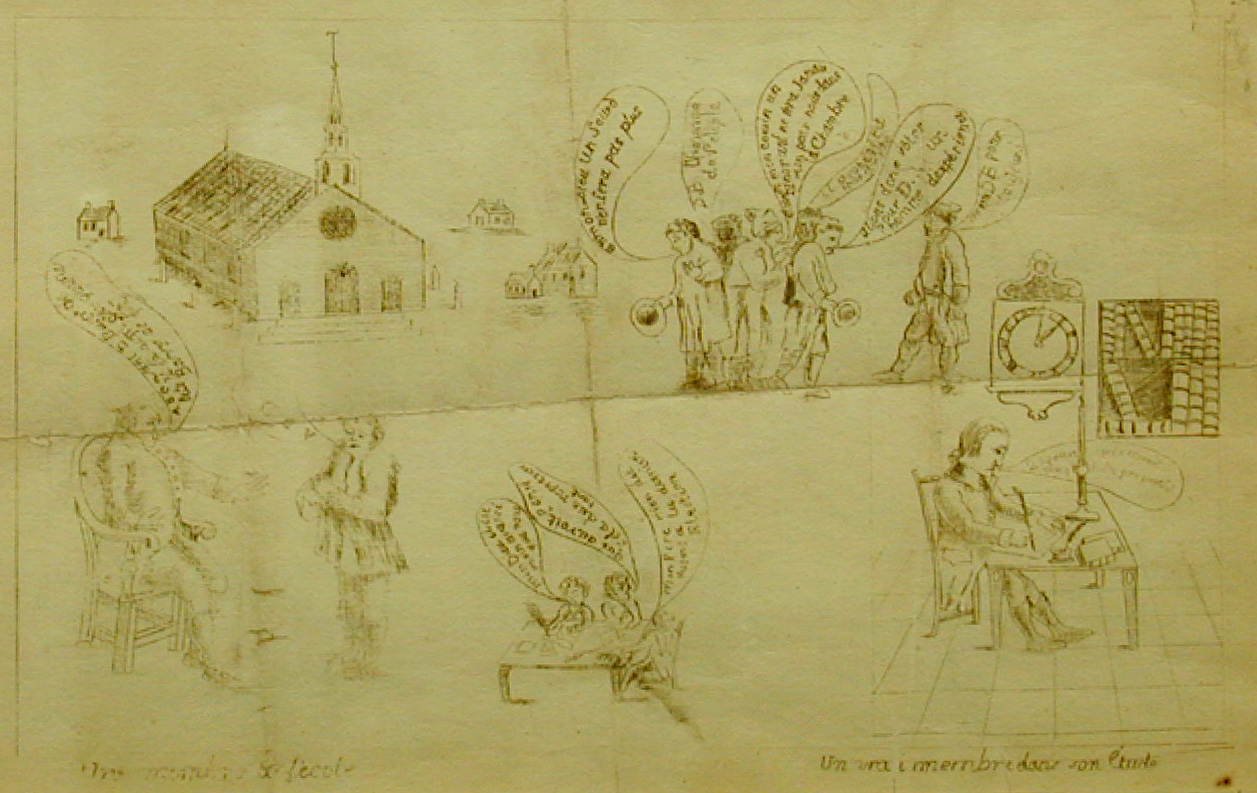
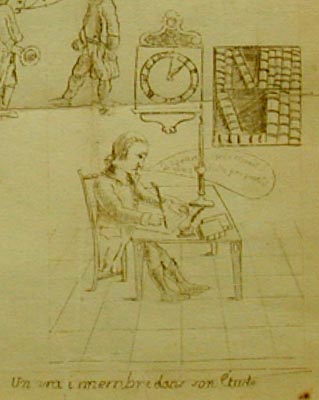
In another caricature of political life, the D.B. initials stand for Pierre-Amable de Bonne (1758-1816), who had close ties to the British authorities. Dulongpré played on the British opinion that part of the French-speaking membership was practically illiterate (left figure). On the oppose side (right figure), an educated Member of Parliament is sitting near his bookshelves with a quill in his hand. In the balloons and captions, the anglicism "membre" and the word "représentant" refer to a Member of Parliament; "Chambre" alludes to the Legislative Assembly;
|
|||||
|
My god a Deaf person will do no more |
D.B. People's representative |
listen my cousin an ignorant will Never do anything for us at the Assembly |
he will stand up for our rights |
so let's go vote for D… a man of experience |
Contempt be held on D.B. forever |
Louis Dulongpré (1759-1843), A School-Member / A True Member in his Study, 1811, ink drawing on paper, 21,5 x 29,3 cm, Montréal, Bibliothèque nationale du Québec, fonds Louis Dulongpré, Mss.147. Photo Robert Derome.
 |
||||
[The professor sitting in his armchair] |
A school-member |
|
||
|
A B C before D Bar headed His is as hard as an Iron Bar |
A B D |
my god he is dragging behind us |
who would have thought that of a representative |
my Father said as much at the last election |
|
|
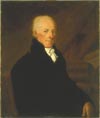
This portrayal of a "true member in his study" is akin to the portraits of Thomas McCord and Joseph Papineau painted by Dulongpré at a later date. |
|
 |
Portraiture usually depicts bourgeois professionals in this position: seated at their desk, well-dressed and surrounded by the attributes of their rank and activities. Such is the case with this portrait of Joseph Papineau. The father of Louis-Joseph Papineau, he was a surveyor, notary, seigneurial agent, Member of Parliament and seigneur. Quills, an ink well, documents and a library containing 200 books at his death illustrate the career and social rise of this great 19th-century family patriarch. Dulongpré painted four copies of this portrait, commissioned by the Papineau family, in 1825. Only two still exist. Joseph Papineau didn't wish to be portrayed, which forced the artist to paint him surreptitiously after their trictrac or chess games. |
|
|
|


