
This period's literate liked to travel in Europe - by way of England -in the West Indies or in the United States. The knowledge they acquired through these trips is felt in their correspondence, diaries (such as Bishop Plessis's) and domestic objects of art such as all-purpose boxes and snuffboxes, often linked to the written word or reading.
|
This miniature described by Mézière in a letter written in 1793 has never been found: "I had a miniature portrait painted of myself so that I could send it to you. If you are worried that the snuff box on which rests this portrait might put you in a compromising situation, give it to some other family who might find it useful. It is said that the likeness is good. You be the judge. Bear in mind, however, that the proximity of the sea and the fish in New York have made me slightly portlier than I was in Montréal. The circle containing the glass can easily be lifted; a flaw that can be put right with strong glue. [free translation of French]" |
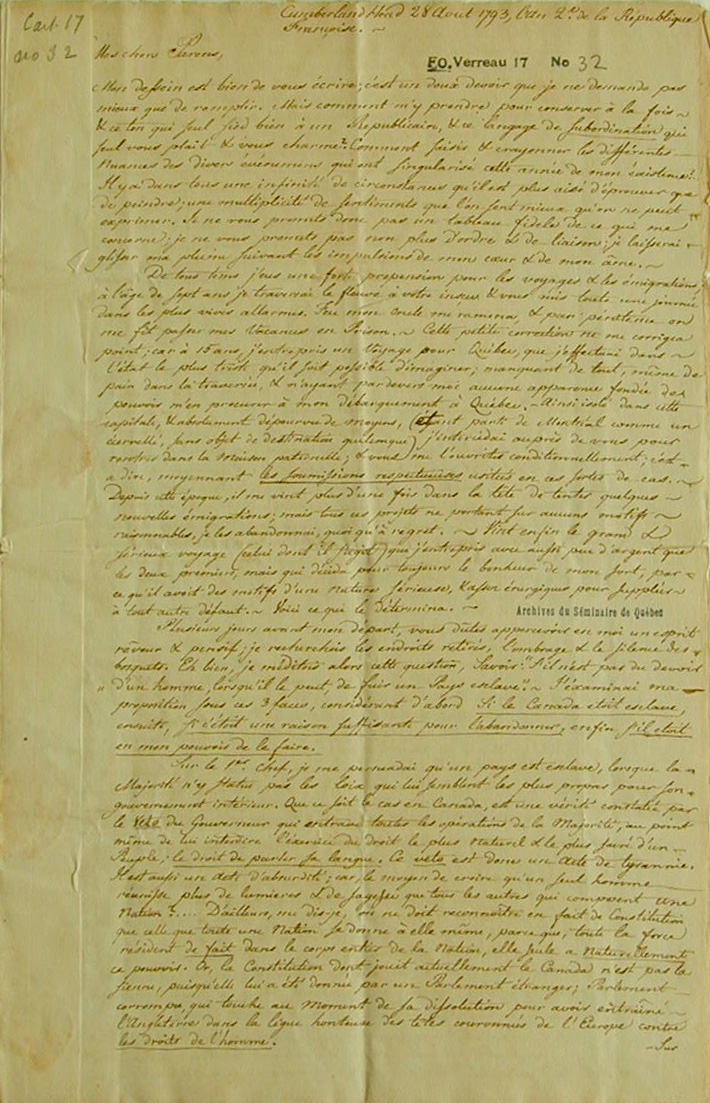 |
|
|
|
This magnificent box was made in Paris before the Revolution. This makes it a most unique artefact since numerous gold and silver objects were melted down at that time. It was most likely brought here before the Revolution by one of the priests in the archidiocese. Bishop Joseph-Octave Plessis might also have acquired it during his trip to Europe in 1819-1820. While on his trip Plessis, who showed an interest in architecture and the arts, increased his modest collection. Father Jean-Baptiste Perras appears to have ordered or even made this miniature in 1828 as a gift for Bishop Panet. There are about thirty posthumous portraits of Plessis. This exceptional social phenomenon has given rise to important iconographic, stylistic and aesthetic essays.
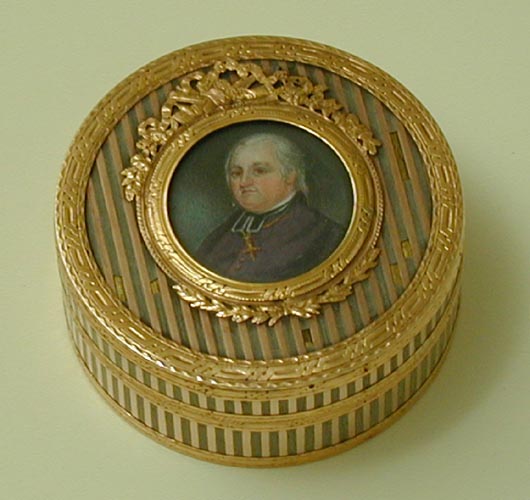
Anonymous ?B, Paris, Box, 1771-1772, yellow gold inlaid with mother-of-pearl, 3,4 cm x 8 cm, Québec, Archevêché de Québec Collection. Photo Robert Derome. |
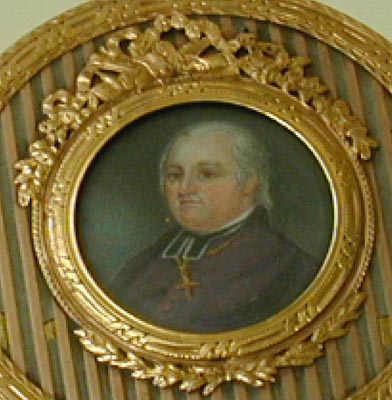
Anonymous, Miniature of Bishop Joseph-Octave Plessis (1763-1825), ca 1828, oil on ivory, Québec, Archevêché de Québec Collection. Photo Robert Derome. |


