Collaboration from Robert H. van
Gent
The Harmonia Macrocosmica (1660, 1661, c.1680 or
later, 1708) of the Dutch-German mathematician and
cosmographer Andreas Cellarius (c.1596-1665) is perhaps one
of the best-known celestial atlases that was published in
the second half of the seventeenth century. Its colourful
and aesthetically appealing double-folio plates of the
Ptolemaic, the Copernican and the Tychonic world systems,
supplemented with numerous other cosmographical plates, have
often been reproduced in the last few decades as
illustrations in books and articles, posters, postcard sets,
calendars, jigsaw puzzles and even as novelty wrapping
paper, while the individual original plates are now-a-days
sold for astronomical prices.
As in many astronomical and
astrological publications from the 16th- and 17th century,
the Harmonia Macrocosmica of Andreas Cellarius is
embellished with an elaborate frontispiece depicting the
most famous astronomers of the past.
The frontispiece, that measures 26
by 43 centimetres, was engraved by Frederik Hendrik van den
Hove (1628/29-1698). He was born in The Hague and worked in
Antwerp, Amsterdam and London. As was pointed out by
Ashworth (1985), Van den Hoveís design for the
frontispiece of the Harmonia Macrocosmica and the
choice of the depicted persons was largely based on the
frontispiece of the Tabulae Motuum Coelestium
Perpetuae of Philips Lansbergen (1561-1632), published
in 1632 by Zacharias Roman in Middelburg
(Zeeland).
The upper half represents the
celestial vault with a radiant Sun, a crescent Moon, the
stars and a portion of the zodiac with the signs of Virgo
and Libra as observed by a pair of putti with cross staffs
while another pair of putti uphold an emblem of the
heliocentric world view and a banner with the bookís
title.
The depicted persons in the lower
half can be identified as follows: seated in the centre with
an armillary sphere on her lap and a ruler, a
marinerís astrolabe and a quadrant at her feet is
Urania,
the muse of astronomy. Seated on the left is the Danish
astronomer Tycho
Brahe (1546-1601) with a
celestial globe and a pair of dividers in his right hand,
and on the right the Polish astronomer Nicholaus
Copernicus (1473-1543)
with a graphometer at his feet and pointing at an armillary
sphere.
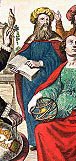
Standing in the background at the
left is the Greek astronomer Claudius
Ptolemy
(c. A.D. 150), clad in a royal mantle and pointing to
a passage in an opened book (the Almagest). Likewise
clad in royal attire and standing to the right of Urania in
the background is the Castilian
king Alfonso el Sabio
(ëthe Wiseí, 1221-1284), holding a model of the
heliocentric(!) world view in his hands ñ an apparent
error of the engraver as this properly belongs in the hands
of Copernicus.
Although the person standing to the
right and pointing upwards with a long stick to an emblem of
the heliocentric world view somewhat resembles the Italian
scientist Galileo
Galilei, he is in fact
to be identified with Philips
Lansbergen. With the
exception of Urania, all the earlier identified persons (and
the emblem!) can be traced back to the frontispiece of
Lansbergenís Tabulae Motuum Coelestium
Perpetuae.
Thus far unidentified remains the
person in the background standing behind Urania and
apparently waving his hand to the viewer. He is the only
person who, except for a closed book in his left hand, does
not seem to have a distinctive feature that can identify
him. Though he has tentatively been identified with the
Islamic astronomer
al-Battani (Ü 929), as
he is also present on the Lansbergen frontispiece, the lack
of distinctive Middle Eastern features suggests that he must
be identified with someone else. Perhaps even, in style with
Lansbergenís frontispiece or that of Keplerís
Tabulae Rudolphinae (1627), with the author himself.
Unfortunately, this hypothesis cannot be verified as no
portrait of Andreas Cellarius is known to exist.
|

 Ptolémée