
By giving Britain a new colony, the Province of Quebec, the Conquest opened the door to the latter's discovery of printing, newspapers, and debating societies: all in all, a favourable forum for the birth of literature. Under the French regime, notable literary works were written by transient French dignitaries looking to please the French public. After the Conquest, Canadians felt a new sense of belonging which prompted their elite to devote themselves to the written word, arts and politics, thus resisting assimilation and tentatively launching the first works of Québec's corpus. Poems of circumstance, open letters, pamphlets, fiction, correspondence, memoirs, paintings, sculptures and engravings were produced just as the American and French Revolutions broke out and the first constitutional debates formed a new basis for collective identity. At the same time, the Colleges of Québec, Montréal and Nicolet introduced educational systems in which rhetoric and the art of public speaking dominated the school curriculum. Rhetoric was the art of persuasive and effective speaking resulting from discursive reasoning and seduction. By making Québec's first generations of literati and orators aware of the power of the spoken word, rhetoric and its teaching contributed to an initial conquest of public opinion in Québec.
Revolutionary unrest put printer and journalist, Fleury Mesplet (1734-1794), in touch with merchant and author, Pierre du Calvet (1735-1786), and American journalist, inventor and politician Benjamin Franklin (1706-1790). A Frenchman settled in Philadelphia, Mesplet came to Montréal with the American Army in 1775. In 1778, he founded a printing shop and a newspaper, The Gazette du commerce et littéraire (Commercial and Literary Gazette). He was soon put in prison for his revolutionary ideas and seditious practices. A Montréal merchant since 1758, du Calvet supported the Americans in 1774. He met Franklin during the latter's stay in Montréal in 1776. Suspected of treason, du Calvet spent almost three years in prison (1780-1783). These events motivated him to contribute to Mesplet's Gazette and, in 1784, to publish an Appel à la justice de l'État where he denounced the autocratic nature of governor Haldimand's administration and formed the basis for the first Canadian constitution.
|
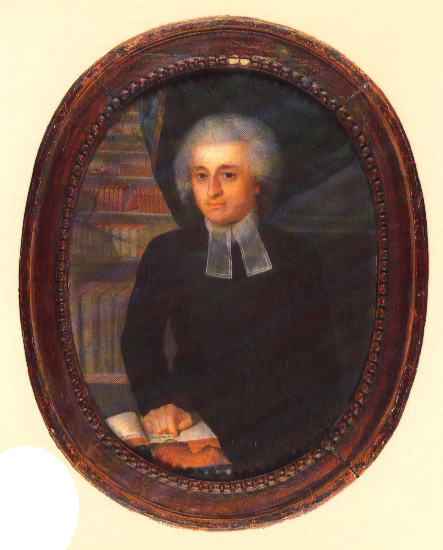
Many have liked to think that Fleury Mesplet is the subject of this portrait even though there is no basis for the identification of either the artist or his model, only the will to put a face on Montréal's printing hero. A sign of mourning, the large black veil behind the head suggests that it could be a posthumous portrait. The black clothes and white band could have belonged to a clergyman, a magistrate or a literate man. The bookshelves, with their numerous copies of books of equal dimension suggest a book shop rather than a library. The seven shelves may allude to Freemasonry since both Mesplet and Beaucourt were members. In the open book, the index is pointing to "Montréal 1794", the date and place of Mesplet's death as well as that of the painter, François Beaucourt, born at Laprairie and active in France, Philadelphia and Montréal. |
 |
|
|
|
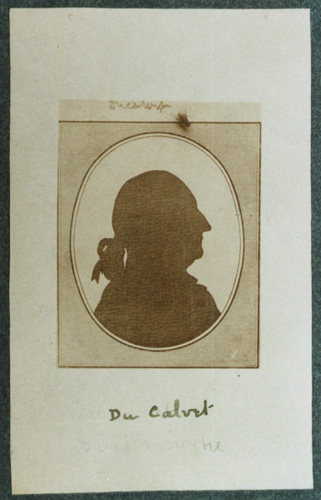 |
This photograph is a "silhouette", that is to say the representation of a person in profile showing only the outline against a contrasting background. This technique was quite fashionable in Montréal during the 18th and 19th centuries. The greatest caution is needed to identify this photographic reproduction of an ancient silhouette since all the information connected to its attribution dates from more than a century after du Calvet's death &endash; of whom this is the only presumed portrait. Although the original has never been found, this photograph bears numerous inscriptions ascribing it to du Calvet. |
|
|
|
|
The clothing and style of this quality engraving, taken from an unidentified book, belong to the French pre Revolution period. J. Cook, Portrait of Benjamin Franklin, 18th century, engraving, 13,6 x 8,9 cm image, Montréal, Château Ramezay Museum, 1998.2432. Photo Robert Derome. |
 |


