
This Alsatian artist came to the colony with the troops of foreign mercenaries hired by England to drive out the American invaders. He worked both Québec and Montréal In 1787, he put an ad in the Quebec Gazette in which "he offered to paint portraits in oil or pastel, landscapes, tapestries of all sorts […] and prided himself in being able teach drawing to anyone wishing to learn in short order [free translation of French]". On 11 February 1788, Father Gravé, Father Superior of the Québec Seminary, wrote to Bishop Jean-François Hubert: "It has become customary in Québec to have one's portrait painted. The portrait of the parish priest [David Augustin Hubert] is very good. I got Bishop L'Ancien [Briand] to have his portrait done, but the result was not as good [free translation of French]". Most of de Heer's works were either abundantly repainted and retouched or destroyed, which often makes it difficult to attribute his portraits.

Attributed to Louis-Chrétien de Heer (1760-before 1808), Portrait of Father David-Augustin Hubert (1751-1792), 1788, oil on canvas, 81,2 x 66 cm, Québec, Musée de la civilisation, Fabrique Notre-Dame de Québec repository, DT179.990. Photographie: Jacques Lessard. |

Attributed to Louis-Chrétien de Heer (1760-before 1808), Portrait of Bishop Jean-Olivier Briand, circa 1788, oil on canvas, 81,1 x 65,7 cm, Québec, Musée de la civilisation, Fabrique Notre-Dame de Québec repository, DT179.990. Photographie: Keld. |
|
On 11 April 1793, the Gazette de Québec announced the publication of this engraving, which may be regarded as Canada's first printed portrait: "JUST PUBLISHED, - (Price Twelve Cents) and on sale at the print shop, An Elegant Portrait of the late Mr. DAVID AUGUSTIN HUBERT, former priest of the parish of Quebec. [free translation of French]" Attributed to Louis-Chrétien de Heer (1760-1808) and an unknown engraver, David Augustin Hubert, priest of the parish of Québec, drowned on 21 May 1792; a compassionate and loving man, 1793, stippled engraving on laid paper, 15,1 x 12,1, Québec, Musée de la civilisation, Séminaire de Québec repository, 1993, 15151. Photo Robert Derome. |
 |
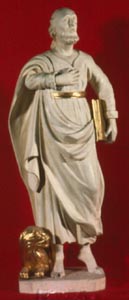 |
Born in Nemours in 1733, the painter and sculptor Philippe Liébert, started working in Montreal as early as 1760. He fought in the American War of Independence from 1776 to 1783, and lived in New York until 1785. After the Conquest, Québec's Roman Catholic Church had to consolidate its position: it rose from its ruins and created new parishes, thus launching artists' careers. The high-altar in Vaudreuil, sculpted between 1792 and 1796, is one of Liébert's masterpieces. In reference to the Gospel of Saint Mark, the book seen in this picture reasserts the power of the Scriptures. Philippe Liébert (1733-1804), Saint Mark, late-18th century, gilded and painted wood, 61 x 25,5 cm, Fabrique de Saint-Michel de Vaudreuil. Photo Robert Derome. |


