From the Conquest until the turn of the 19th century, a first generation of men and women tried its hand at writing and debating in private and public texts. Influenced by the philosophical ideas of the Age of the Enlightenment, these forbears of literary culture thus promoted a new interest in matters of the mind, created new meeting places for society - such as circles, theatres and reception rooms - and developed epistolary networks. These women and men embody the first blossoming of literature in Québec. Men such as Luc de La Corne Saint-Luc told of shipwrecks or held controversial opinions about battles. Pierre de Sales Laterière, his friend Marie-Catherine Delezenne, Marie Mirabeau (Mesplet's wife) and the like wrote their memoirs or petitions. They described Canadian customs and held salons, as did Frances Moore Brooke.
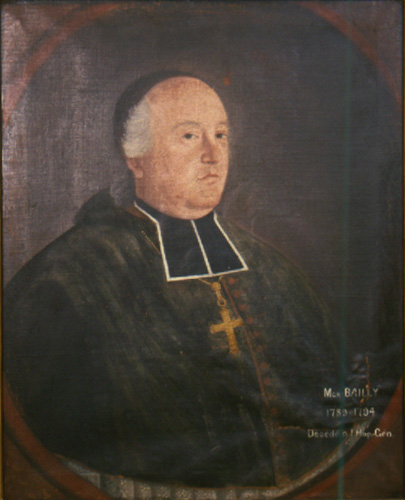 |
Bailly was born in Varennes in 1740. His parents sent him to complete his education in Paris at the very end of the French regime. He became a priest upon his return to Canada in 1762, and in 1774, taught rhetoric at the Seminary of Québec. A socialite and cosmopolitan man, he soon was a regular at the salons of governor Guy Carleton - later known as Lord Dorchester - reception room, and became private tutor to his children. Lady Dorchester might have ordered this portrait from de Heer to serve as a gift in honour of Bailly's promotion to coadjutor. It remained at the Hôpital général, where Bailly died. It is one of the few works ascribed to de Heer that has not been repainted. |
|
|
|
|
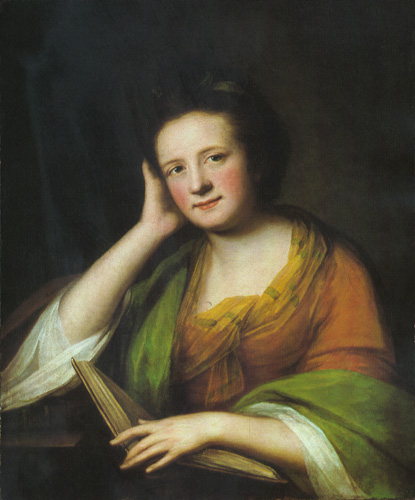
Born in England, Frances Moore was introduced to literature at a very young age. She wrote poetry and plays and edited the weekly The Old Maid. She ended up in Québec with her husband, the reverend John Brooke, in 1763. There, she held meetings and socialised with intellectual circles. In 1768, she returned to England with the manuscript of The History of Emily Montague. This epistolary novel published in 1769, one of the first to depict the life of Canadians, became compulsory reading for all travellers. It showed her to be a quick-witted and refined woman. It also revealed the close friendship between herself and the British painter, Catherine Read, whose work was then very popular. Her paintings sold at prices as high as those of the period's most famous artists. |
 |
|
|
|
|
|
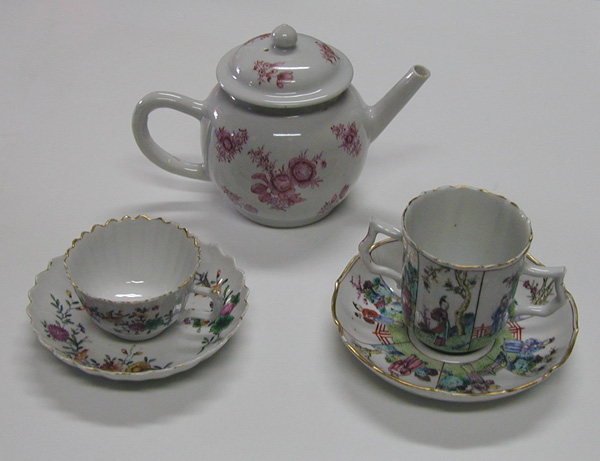
Chinese tea pots were found in New France as soon as the early-18th century. Despite its outrageously high cost, tea was very popular. Franquet tells us that in 1753: "at the intendant's house, one could expect to be served tea, coffee and chocolate [free translation of French]". The British introduced "the ceremony and ritual of serving tea" in reception rooms after the Conquest. Frances Moore Brooke and Elizabeth Posthuma Gwillim, known as Lady Simcoe, have described the social conventions of this period. |
|
|
|
 |
Nicknamed "The Savages' General", Canadian-born La Corne successively served in the French and British armies. A merchant, interpreter and member of the Legislative Council, he was the author of a travel diary that recounted the wreck of the Auguste in 1761. Published in 1778, by Fleury Mesplet, six years before Pierre du Calvet's Appel à la justice de l'État, this Journal is the first adventure story written by a Canadian to be published here in book-form. The wealthy La Corne was keenly interested in both clothing and works of art. We have many miniatures of him and his family. This portrait may be the second of two oil portraits painted in England in 1763-1764 and 1778. |
|
|
|