
The end of Napoleon's Continental Blockade (1815) re-established the freedom of movement of people, trade goods and ideas. Literature, painting and music flourished at a rapid rate. Books filled Bossange's and Fabre's bookstores in Montréal. With the Desjardins paintings, artworks crossed the Atlantic again. These factors contributed to the release of patriotic poetry in the 1830s. Two social novels were published in 1837: L'influence d'un livre by Philippe Aubert de Gaspé junior and Les Révélations du crime ou Cambray et ses complices by François-Réal Angers. Pierre Petitclair's play, Griphon ou la Vengeance d'un valet, was also released. The struggle against the colonial elite and soon after, Britain, was more or less intense: John Neilson and Denis-Benjamin Viger did not necessarily follow in the footsteps of the more radical Louis-Joseph Papineau, Ludger Duvernay or Napoléon Aubin who were, however, more moderate than Édouard-Étienne Rodier or Louis Bourdages. Political and ideological turmoil even reached the Sulpician's College and the Saint-Hyacinthe Seminary, while several political figures went around the Québec Seminary where young Cyprien Tanguay was studying. Bishop Jean-Jacques Lartigue and Edward Ellice, Katherine Jane Ellice's father-in-law, represented the strongest loyalist opposition to the ideas and practices of the Patriot party.

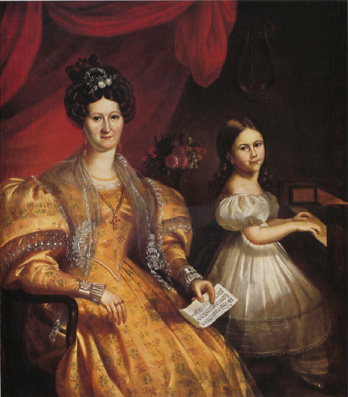
Antoine Plamondon (1804-1895), Julie Papineau born Bruneau (1795-1862) and her daughter Ézilda (1828-1894), 1836, oil on canvas, 121,8 x 107 cm, Ottawa, National Gallery of Canada, bought in 1974, 17920. Photographic reproduction. |
Antoine Plamondon (1804-1895), Louis-Joseph Papineau (1786-1871), 1836, oil on canvas, 122 x 106,5 cm, Ottawa, National Gallery of Canada, bought in 1974, 17919. Photographic reproduction. |
Commissioning a portrait of a husband, a wife or even of the whole family was common practice among the middle-classes. The dress, muslin scarf, jewellery, red hanging and flowers all contribute to the imposing social bearing of this painting. The musical score, the piano, the harp hanging on the wall associate music with femininity. Publicly displayed, this diptych was also part of a political strategy which was quickly denounced by newspapers: they went so far as to compare the ornament in Madame's hair to a premature royal crown!
Many different portraits of Papineau were printed and sold in book shops and print shops. Majestic and ambitious, this painting was made at the peak of both Papineau's and Plamondon's careers. Its golds and dark browns, the red hanging, the white on the jabot and flap give prestige to the leader of the Patriote party and president of Lower Canada's Assembly. He is also depicted with the two major attributes of 19th-century literate culture: eloquence and writing. Sitting at his desk, hand laid on a document near his luxurious writing case and quill, Papineau appears to be preparing a speech or an intervention at the Assembly. He founded his political thoughts on Greek, Latin, English and French authors: Cicero, Aristotle, Demosthenes, Montesquieu, Jefferson and Fox.


