
The water-colours of Cockburn and Ellice show images of daily life and various forms of printed matter: the poster put up in a public square, reading, books, music played in the intimacy of a seigneurial manor. The connection between public and private life is further subtly expressed in the portrait of Cyprien Tanguay: through references to rhetoric, writing, reading and books used in the school curriculum; through the depiction of both the English and French styles of bookbinding.
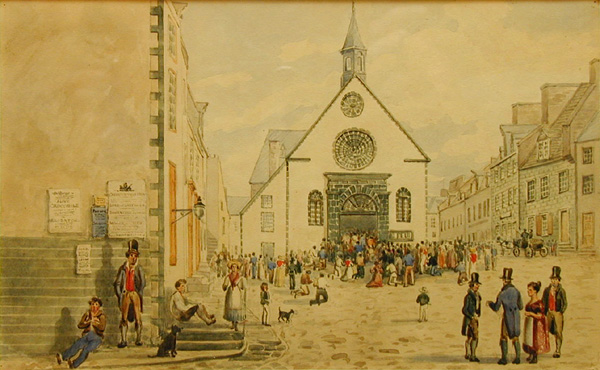
James Pattison (or Patterson) Cockburn (1779-1847), Lower Town Church & Market Place Quebec, ca 1821-1832, water-colour, 15,3 x 23,9 cm, Québec, Musée de la civilisation, Séminaire de Québec repository, 1993.23300. Photo Robert Derome.
A British army officer, Cockburn was trained in England as an artist-topographer. He briefly visited Québec City from 1821-1823, and again between 1826 and 1832. His friend Lady Aylmer drew a stunning portrait of the Colonel in a letter dated January 1831 to her nieces, included in her "Recollections of Canada":
"I have just forwarded to England for you a little book lately published here, of which the drawings are Engraved from the beautiful sketches taken from nature by Colonel Cockburn, who commands the Artillery at Quebec, and who is one of the most accurate and Elegant Artists I have ever met […] He has an immense and most Valuable collection of his own drawings in every part of the world he has travell'd over and some color'd from Nature. He continues (at his present age) to be indefatigable, and his passion for the beauties of nature can only be gratified by his unceasing perseverance in delineating them."
|
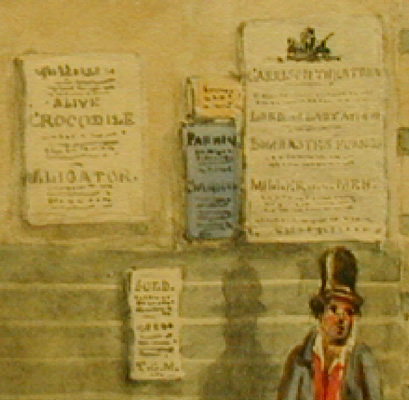
The poster, one of the many forms of printed matter used in the public forum, is by its very nature rare and difficult to preserve. This water-colour shows posters glued to the Fornel house. These posters advertised a show with a live crocodile, sales and a performance by the Garrison Theatre. |
 |
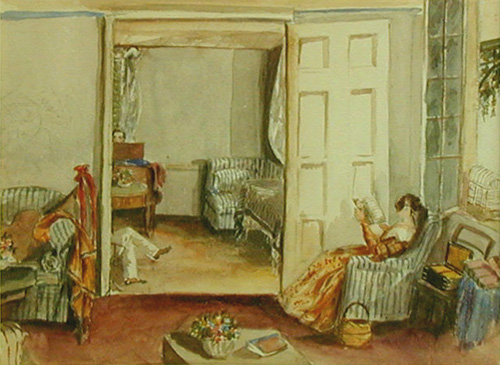
Katherine Jane Balfour-Ellice (ca 1814-1864), The Interior of the Seigniory House at Beauharnois, Lower Canada, 1838, water-colour, 6 1/2 x 8 3/4 inches, Ottawa, National Archives of Canada, I-6. Photo Robert Derome.
Jane Ellice arrived in Québec City with her sister Églantine Balfour in 1838. She was also accompanied by her husband, Edward junior, who had just been named private secretary to Lord Durham, governor of Lower-Canada and author of the controversial report. At her father-in-law's request, Jane kept a diary of her trips to Canada and the United-States. She also included her thoughts on the Rebellions, when she and her sister were confined in the seigneurial manor-house of Beauharnois. An accomplished artist, Jane Ellice captures and renders, the charming disorder of a private instant in the people engaged practice in art and literature. The picture shows a guitar or cello on an armchair, the legs of a seated protagonist, a man playing the piano, a woman reading, books scattered about everywhere and a box of water-colours.
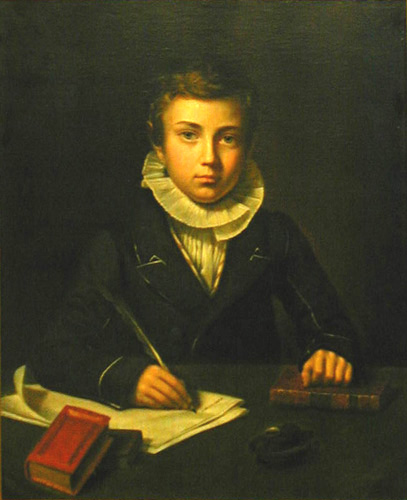 |
In a speech given in 1863, Cyprien Tanguay declared he had seen many prominent literary figures walk the corridors of the Seminary. Brilliantly portrayed by Plamondon, Tanguay wears the seminarist's costume. His left fist rests on a book by Cicero, the celebrated Roman orator. He is writing the word Cicero with his right hand, thus insisting on the educational importance of rhetoric. As for the two other books, one is bound in the English-style, the other in the 18th-century French style. The presence of these two influences illustrates the cultural interbreeding of Québec society. |
|
|
|
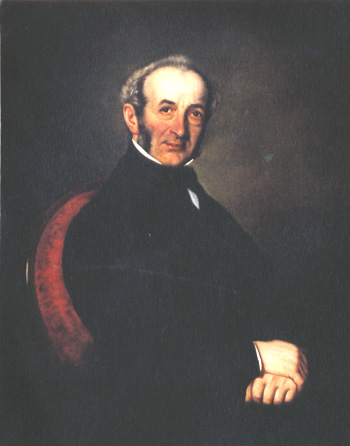
Théophile Hamel (1817-1870), Marc-Pascal I de Sales Laterrière (1792-1872), 1853, oil on canvas, 94 x 74 cm, Montréal, Power Corporation of Canada Collection. The youngest son of Pierre de Sales Laterrière, Marc-Pascal was a medical doctor, seigneur and politician. A surgeon with the 6th Militia Battalion of Lower Canada during the 1812-1814 American Invasion, he subsequently practised in Québec before becoming seigneur of Les Éboulements in 1816. A Parti Canadien partisan, he was elected to represent the riding of Northumberland (Saguenay). Member of the Special Council from 1838 to 1841, he did not attend any of its sessions and publicly stated his opposition to the Union. Also opposed to Confederation, he died at Les Éboulements in 1872 after having attended to the publication of his father's memoirs. |
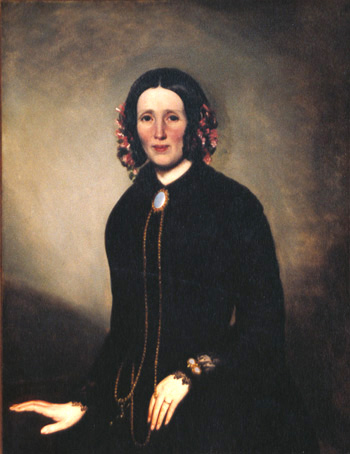
Théophile Hamel (1817-1870), Eulalie-Antoinette Dénéchaud (1812-1900) the wife of Marc-Pascal de Sales Laterrière, 1853, oil on canvas, 94 x 74 cm, Montréal, Power Corporation of Canada Collection. Abbé Casgrain remembers Eulalie Dénéchaud, whom he met during a visit to the seigneurie of Les Éboulements: "Younger than her husband, [she] has kept the strength and freshness of maturity, but life's hardships and the cruel losses which have forever scarred her mother's heart have thrown on her sweet physiognomy a touching veil of melancholy [free translation of French]". This magnificent portrait shows the evolution of visual arts after 1840 through the work of Théophile Hamel, a talented artist trained by Antoine Plamondon from 1834 to 1840. |


