 Ptolémée
Ptolémée
Ptolémée
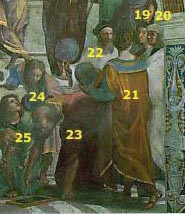
Raphael (Raffaello Sanzio 1483-1520), Detail of Ptolemy and Strabo in the School of Athens (Scuola di Atene), 1509-1510, Vaticano, Stanza della Segnatura. |
 |
Raphaël (Raffaello Sanzio 1483-1520), Détail de Ptolémée et Strabon dans l'École d'Athènes (Scuola di Atene), 1509-1510, Vaticano, Stanza della Segnatura. |
"The 'emblematic image' on the tablet
held at Pythagoras's feet is the clue that the fresco is
about the mathematical harmonies of the universe. Balancing
the Pythagorecians around the slate at the lower left are
the astrologers, symmetrically placed on the other side of
the foreground. These two groups are rightly represented as
conterparts, for what the Pythagoreans defined with musical
consonances, the astrologers found out by studying the sky.
Plato's raised finger expresses a final connection: from the
science of numbers comes music; from music comes cosmic
harmony; and from cosmic harmony comes the divine order of
ideas (p. 34). Euclid,
Zoroaster, Ptolemy, all tracked divinity in the regular
patterns of geometry and the stars (p. 156)." Apart the four identifed persons, the two globes are
essential components of this group: the celestial one held
by Strabo and the Earth held by
Ptolemy. Closely linked with Raphael self-portrait, these
figures and objects thus become a reflection on the realms
of representation in science, both of the universe and the
humans within, but also of art and its works, either in
theory or in practice. 19. The Greek painter Appelles, shown as a
self-portrait by Raphael who had been nicknamed by
Vasari the "new Appelles" (Joost-Gaugier 1998,
p. 780-83). "Cleverly, Raphael has placed himself among the champions
of sight, his own endeavors thereby elevated to the same
plane: he, too, has measured the traces of divinity an
sought God in the beautiful (p. 156). Raphael, author
of the work, painted from his image in a mirror, with a
black cap on his hea, of noble aspect, modest, and imbued
with grace... (p. 53)." Raphael is directly gazing at
us, as if he was questionning what we thought about his
painting. 20. Greek painter Protogenes shown as
Raphael's good friend, the painter Timoteo da Urbino
(Timoteo Viti) with whom he had professionnal and personnal
contacts when he painted this frescoe (Joost-Gaugier 1998).
Maybe a reference to homosexuality linked with these men
professionnal activity as painters? 21. Joost-Gaugier demonstrates that this figure
seen from the back is Ptolemy, being a Greek living
in Egypt. Raphael used the motif of the crown found on coins
from the "dynasty of Macedonian kings of the same name who
ruled Egypt from 323 to 30 B.C." (Joost-Gaugier 1998,
p. 766-767, note 13.) Ptolemy firmly holds the Earth with his both
hands playing with the universe and its
representation as in his
famous quotation in a 1453 manuscript of his
Geographica. This is a completely new
iconography, since Ptolemy used to be shown as an
atronomer with an armillary sphere, an astrolabe or
a quadrant (see
several previous images in the menu on the
left). This innovative iconography,
through Raphael's genius interpretation, is closely
linked to the printing of Ptolemy's
Cosmografia in the 15th century. "While the
Almagest did not receive its first printing
until 1515, by that year at least twelve editions
of the Geography were in print.
[...] Book 7 of Ptolemy's Geography
includes instructions for constructing a globe
(Joost-Gaugier 1998, p. 767-769)". This cosmography of the Earth cannot be separated from
the celestial cartography, closely held by Strabo.
Ptolemy is very close to Raphael the author of the painting,
thus demonstrating the very importance of his contribution
to the understanding of cosmology, cosmography, geography,
the realms of the theory of the universe and its symbolic
representation, in science and in art. Hiding Ptolemy's face
was a good thing to do, since his portraits are fictions or
recreations. This figure of Ptolemy was until recently identied as:
"Zoroaster, whose back is turned, hold[ing] a globe
of the heavens (p. 22)". This identification was rooted
in the accounts of Giorgio Vasari (1550) and Giovanni Pietro
Bellori (1695). "Behind Archimedes [Euclid]
come two sages: one holds the celestial globe marked with
the stars, the other the globe of the elements, with the
surface of the earth and the water. [...] The second
one turns his back, so that his face cannot be seen, but the
radiate royal crown and the golden mantle are attributes of
Zoroaster, king of the Bactrians, who apart from astronomy
was most expert in the science of natural things; even
though it is thought that he corrupted the true science of
the occult (p. 53, 156)." Joost-Gaugier 1998 sustain
that this interpretation cannot be retained because
Zoroaster was not an Athenian, nor a Greek, and that
humanists stressed his ties rather with Plato (left side of
painting) and not with Aristotle (right side). Thus he has
no place in a frescoe dedicated to The School of
Athens. On other hand, pope Julius, as patron of this
commission for his private library, had no known interest in
Zoroastrism. We think along with Bellori and Joost-Gaugier
that this figure of Ptolemy is holding a terrestrial globe,
pairing the celestial one held by Strabo. 22. Strabo,
a Greek geographer, is here represented by Raphael
trough the portrait of Castiglione. Strabo
is holding a celestial globe, almost spinning at
the tip of his right hand's fingers. To Renaissance
humanists, Strabo was
considerered as a philosopher who insisted to
consider the Earth linked with the celestial
universe. Translation of his Geography in
latin was commissionned by Pope Nicholas V in the
1450s. A manuscript edition was owned by Julius II.
Strabo was often
linked with Ptolemy, as a pair, by Renaissance
humanists. (Joost-Gaugier 1998) This figure was formerly identified as
the one of Ptolemy (p. 34, 59, 94). Giovanni Pietro
Bellori (1695) was referring "to the Chaldeans, authors of
astronomy and of the science of celestial bodies, and his
chest and the cap on his head are visible (p. 53,
156)." Joost-Gaugier 1998 studies the group of men on the
lower right side of Raphael's School of Athens. While the
portrayal of Euclid is
undisputed, the figures who are attached to him have not
yet been firmly identified. In studying these figures as
part of the intellectual fabric of the painting as a
whole, it becomes clear that each of these figures has a
meaningful role that cannot be deduced by mere guessing.
The figure with his back to us is quite clearly the great
mathematician-cosmographer Ptolemy of Alexandria. Not
only because he wears a particular crown, but more
importantly because the globe he holds is terrestrial (a
symbol of his scientific contribution to the humanist
curriculum) can we be certain of his presence. The man
who faces him is most likely Strabo,
the most famous geographer known throughout medieval
times and one who was also appreciated by humanists,
especially for his consideration of the sphere and the
celestial aspects of the universe in his Geography. Both
Ptolemy and Strabo are well
placed next to Euclid, for both
are concerned with geometry. The two men to the far right
are, it is suggested here, two famous painters of Greek
antiquity, Apelles (in the guise of Raphael) and
Protogenes (in the guise of Timoteo Viti?), whose
presence reflects the interests of artists in the early
Cinquecento. All these heroes are appropriately placed on
Aristotle's side of the painting. (Thanks to an
Anonymous correspondant for this information.) This remarkable piece of scholarship litteraly changed
the "face" of the Ptolemy's website, since the Raphael
portrait was used as the index button. I spent a marvelous
week-end reading this article and adapting its information
to the website. I also found some new portraits from the
footnotes and references. Formerly the old bearded man was used, now identified as
Strabo as a web button. It has been replaced by the no face
Ptolemy seen from the back. I find this quite appropriate to
look at the back of this gentleman, since all his
iconography is an imaginary one. It goes along with the
reflection on his iconography, looking backwards to what
everyone said about him without never being able to see his
real face. A kind of backwards mirror of the ideologies of
the epochs when his portraits were made.


For another opinion on the identification of
Ptolemy in Raphael's "School of Athens" see this article:
Joost-Gaugier 1998 - Joost-Gaugier,
Christiane L., "Ptolemy and Strabo
and Their Conversation with Apelles and Protogenes:
Cosmography and Painting in Raphael's School of Athens",
Renaissance Quarterly, Volume LI, Number 3 (Autumn
1998), p. 761-787.


 |
 |
|
  |
 |
  |
Anonymous correspondant.
Pierre Perroud, Athena Raphaël, The School of Athens, Université de Genève.
Hall 1997 - Hall, Marcia B. (edit.), Giovanni Pietro Bellori, Heinrich Wölfflin, Ralph E. Lieberman, Janis Bell, Timothy Verdon, Ingrid D. Rowland and Alice Sedgwick Wohl, Raphael's School of Athens, Cambridge (U.K.), Cambridge University Press, 1997, 182 p., ill.. PAGES NUMBERS ALL REFER TO THIS BOOK.
Joost-Gaugier 1998 - Joost-Gaugier, Christiane L., "Ptolemy and Strabo and Their Conversation with Apelles and Protogenes: Cosmography and Painting in Raphael's School of Athens", Renaissance Quarterly, Volume LI, Number 3 (Autumn 1998), p. 761-787.
Ptolémée
