 |
TEKAKWITHA. |
 |
1949 Angel, un regard vers le ciel.
John Angel (1881-1960), Ven. Kateri Tekakwitha, Lily of The Mohawks, 1949, bronze, Portes de la Cathédrale Saint-Patrick, New York. Photos : Jamilur Reja, Marcela Villa, Joenard Camarista, Fr. Shawn Tunink, alamy, Anthony Jalandoni. |
|||||||
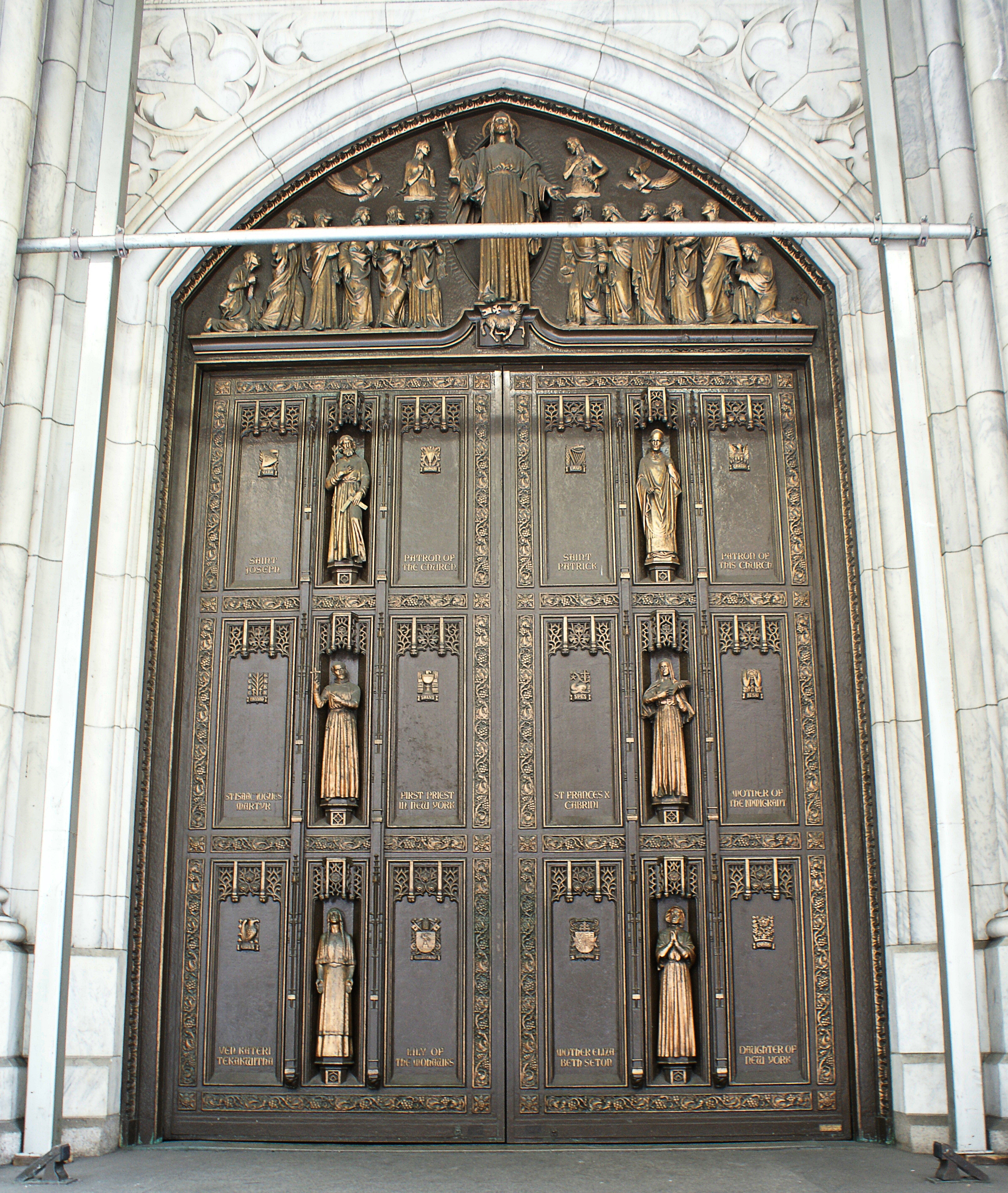

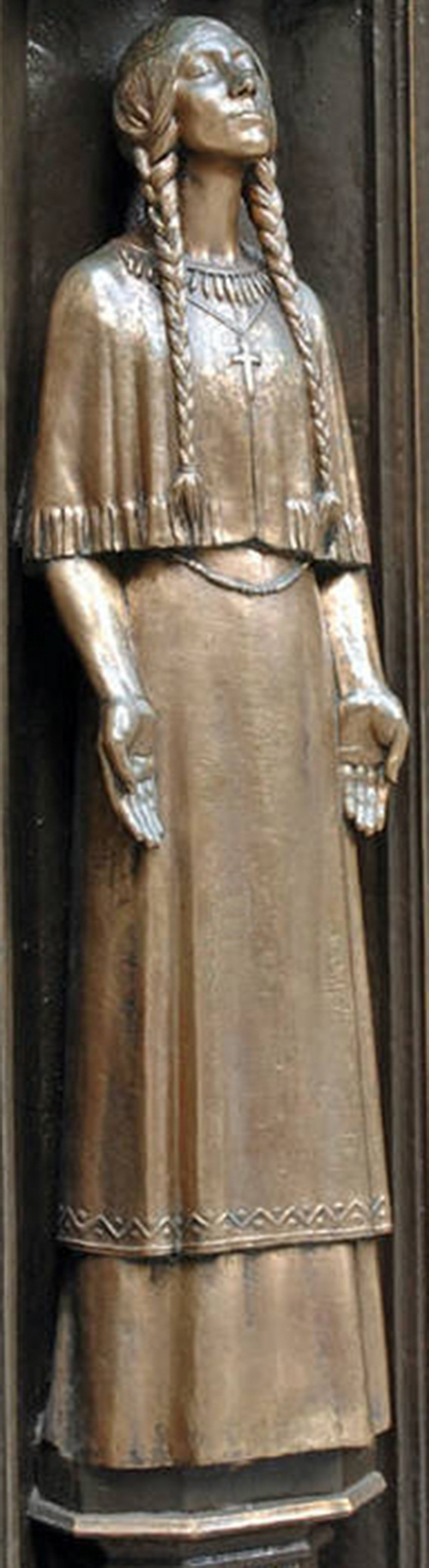
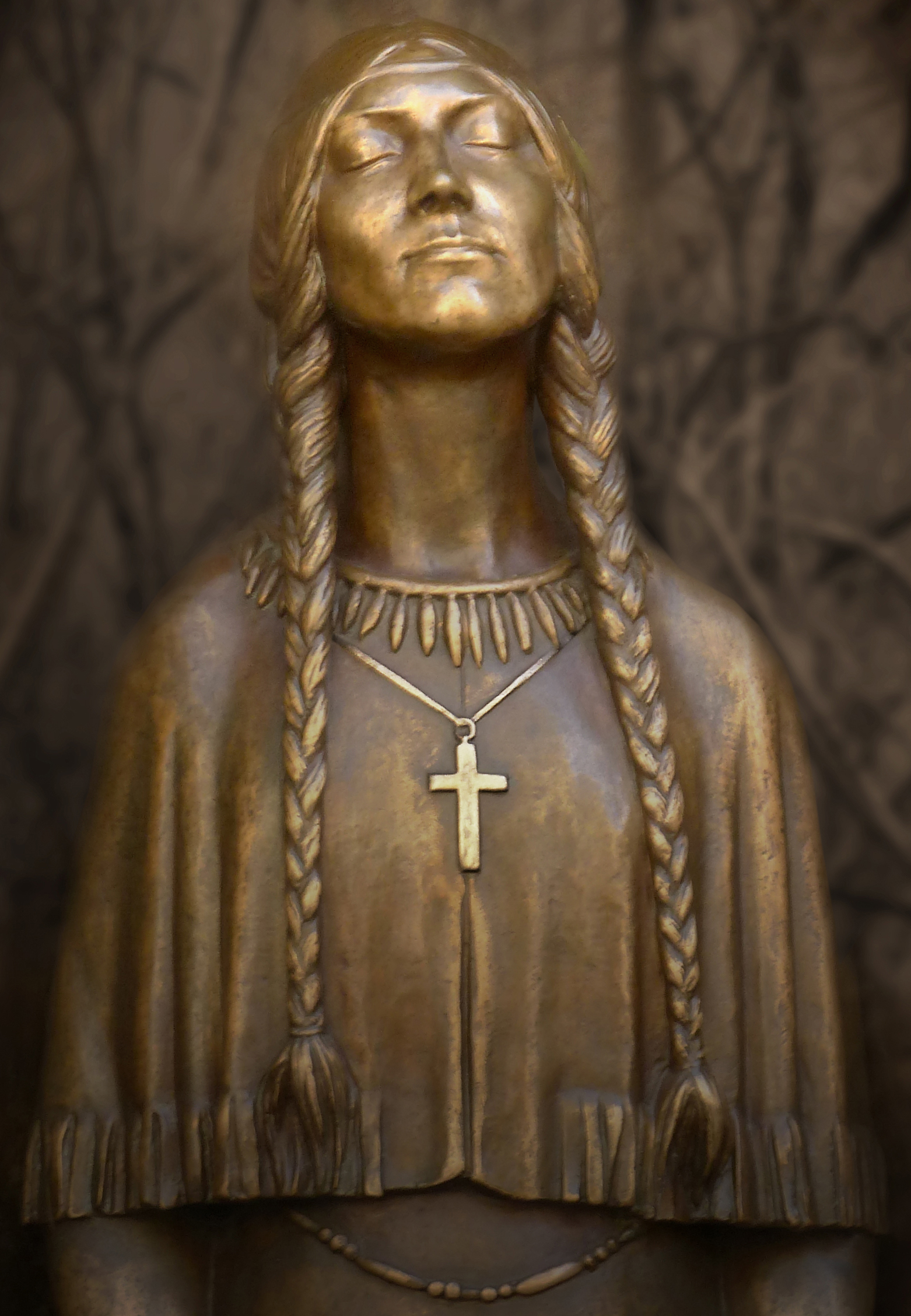
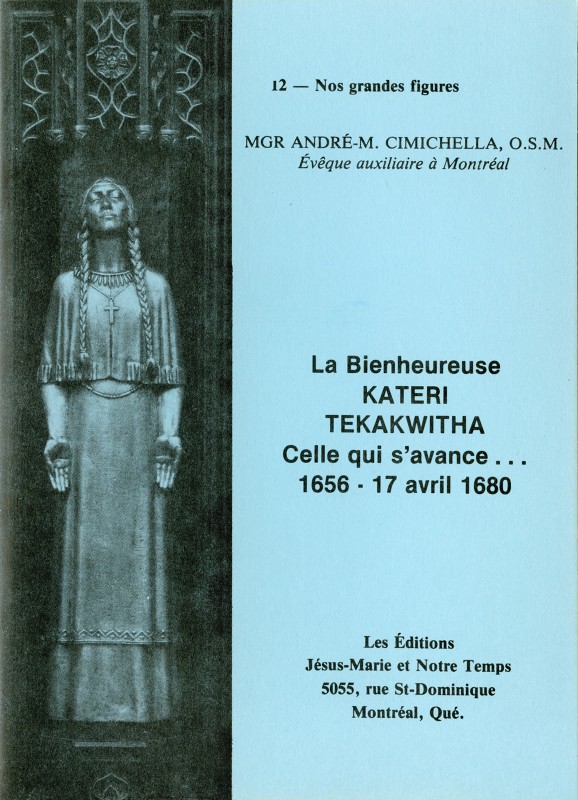
Les massives portes de bronze de la Cathédrale Saint-Patrick de New York marquent le retour triomphal de ce matériau de nouveau disponible après la Seconde Guerre mondiale. Elle sont inaugurées en 1949 (web ou pdf ou txt) après plusieurs années de travaux (web ou pdf). Tekakwitha y occupe une place importante aux côtés des saints Joseph, Patrick, Jogues, Françoise-Xavière Cabrini et Elizabeth Ann Seton, alors qu'elle vient tout juste de devenir vénérable depuis 1943. Remarquons l'équité de nombres entre les femmes et les hommes, quoique ceux-ci occupent toujours le haut de la hiérarchie ! John Angel y accentue l'élévation vers le ciel par la stature filiforme issue du Moyen Âge, les mains ouvertes en signe de piété, visage rayonnant tourné vers le ciel les yeux fermés, tresses et croix en pendentif. La sculpture aurait été installée à l'automne 1949 selon Kateri qui en donne une illustration en 1950 (Kateri 1950.09-EV02N04p08) tout en lançant un vibrant appel à doter Caughnawaga d'un bronze qui sera celui de Brunet selon la campagne de financement qui vient tout juste de débuter. L'oeuvre de Angel servira de couverture à quelques livres. |
|
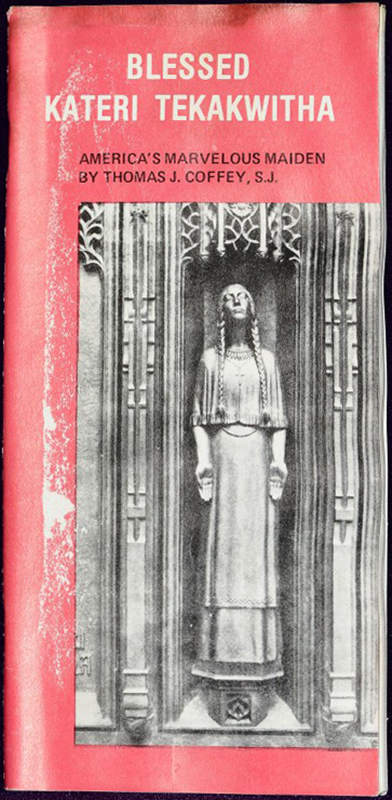
LM 1950.01-02 — (p17) « TEKAKWITHA ON FIFTH AVENUE We stood in the midst of the milling crowds on the sidewalk in front of St. Patrick's Cathedral in New York on Christmas Day. We were pushed aound a bit, but we just purred, as proud as a whole parade of peacocks. For visitors from all over the land were snapping to gape at the new bronze doors of America's best-known church, and there, for all to see, immortalized in bronze, was our Kateri Tekakwitha, who has finally 'come into her own' as part of the metropolitan scene. [...] The sculptor, Mr. John Angel, wants us to consider the tympanum (the space within the arch above the doors) and the doors, as a whole, having seven dominant notes. The most important of these is Christ, represented in a sixty-three inch statue as Redeemer of the world, giving to His Apostles His supranational mandate. Go, teach all nations The Blessed Virgin and St. John the Baptist are in the upper section of the composition, and the twelve Apostles below. The other six dominant notes are made by the statuettes in the doors below. These figures are each thirty-seven inches high, standing in niches, one above the other, three to a door. The two upper statuettes are St. Joseph, Patron of the Universal Church, and especially dear to workmen, and St. Patrick, Patron of Ireland and of the New York Cathedral. The middle figures are of St. Isaac Jogues (1607-46) and St. Frances Cabrini (1850-1917). Father Jogues, first priest in Manhattan, canonized June 30, 1930, as one of the eight North-American Martyrs, is represented in the habit of the Jesuit Order, preaching to the Mohawks, whose Apostle he was. Mother Cabrini, canonized July 7, 1946, as the first United States citizen to be raised to the altars, is entitled Mother of the Immigrant, and is represented with a book, to denote her interest in religious teaching. In the two lower niches there stand Kateri Tekakwitha, declared Venerable by Pope Pius XII January 3, 1943, and Mother Elizabeth Ann Seton, whose Cause has been introduced. Tekakwitha (1656-1680) is represented as attired in typical Indian dress, with a leather tunic and beads. She stands absorbed in perfect union with God in prayer. [...] The choice of these six personalities, all related to the State and ecclesiastical Province of New York, typifies, in a way, the cosmopolitan character of the Church in New York. There is a Jew (St. Joseph), a Celt (St. Patrick), a Frenchman (St. Isaac Jogues), and Italian (Mother Cabrini), an aboriginal (Venerable Kateri Tekakwitha) and an Anglo-Saxon American (Mother Seton). They symbolize New York and America, the 'melting pot,' and project concretely the supranational character and message of the Church. »
|
1950.09
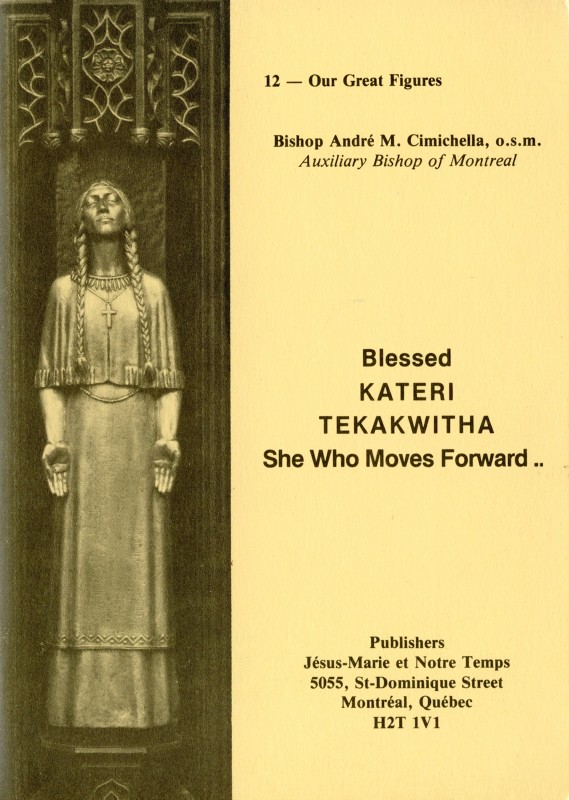
Angel, Ven. Kateri Tekakwitha, Lily of The Mohawks, 1949, bronze, Portes de la Cathédrale Saint-Patrick, New York. — (Kateri 1950.09-EV02N04p08 ; 1967.12-F030-031p34 ; 1983.03-E135p19 ; 1983.03-F092p19 ; 1985.03-E143p12 ; 1985.03-F100p12 ; 1991.06-E168p23 ; 1991.06-F125p23 ; 1996.09-F146p06 ; 2018.12-E270p03) ; (Cimichella 1980, 1981 et 1984, p. couverture). |


 |
Il n'est pas étonnant qu'en 1952 le directeur du Camp Tekakwitha, le « Père D.M. Clark » tel qu'identifié sur cette photo noir et blanc, pose devant la scupture de sa patronne conçue quelques années plus tôt par Angel pour les portes de la cathédrale St. Patrick de New York, accompagné de trois prêtres portant des t-shirts au logo du camp : Jacques Allard, Benoît Poulin et Luc Allard.
La transmission de l'influence de Tekakwitha persiste chez l'ancien campeur Denis Fortin photographié en couleur devant la même sculpture d'Angel. |

LM 1980.06 — (p14) NOTES FROM THE BARK by father mcbride • The Society for the Propogation of the Faith of the New York Archdiocese has produced a poster depicting Kateri on the doors of St. Patrick's Cathedral along side the important dates in her life incIuding June 22, the day of beatification by Pope ]ohn Paul II. It is done in six colors. A copy may be obtained by writing here and sending $1.50 which includes postage and handling. A special liturgy still is on the calendar at St. Pat's for Octobe 19, Mission Sunday, to comemorate Kateri's beatification.
|
TEKAKWITHA. |
|